I Asked GPT-5.5 to Code in Goblin Mode. Did it affect its performance?
OpenAI patched a verbal tic out of their model. The patch ships in Codex via a developer prompt, not in Copilot, so in Copilot the goblins still appear. I ran the experiment I was curious about: does goblin mode actually change coding performance, or is it just vibes?

A few weeks back, OpenAI published Where the Goblins Came From, a short post explaining why their GPT-5 series had been sprinkling “little goblin” and “tiny gremlin” into its answers. Short version: a reward signal attached to a personality option called “Nerdy” had quietly been giving higher scores to outputs that used creature metaphors, so the metaphors spread. They removed the signal, retired the personality, filtered the offending family of words from later training, and shipped a developer prompt for Codex that suppressed the residual tic.
The developer prompt only ships in Codex. I use GitHub Copilot for work, which doesn’t apply it, so in my editor the goblins still show up. Usually it’s a single sentence. Once in a while the whole answer comes out in character.
I’d been ignoring it until I started wondering whether the goblin was doing anything to my code or just decorating it. So I told the model, explicitly in the prompt, to be in goblin mode and embrace it freely, and asked it to solve real problems.
Here is what gpt-5.5 thinks goblin mode looks like when solving AIME 2025 problem 4:
Goblin counting time.
A number is divisible by 22 iff it is divisible by both 2 and 11. Let the digits be d₁d₂d₃d₄d₅d₆d₇d₈…
And on problem 7 (a geometry problem about a circle and a perpendicular bisector):
Goblin geometry time.
Let z = x + yi. The first equation is a circle…
And on a base-arithmetic problem, gpt-5.4 ended its solution with this kicker:
Tiny goblin check: shiny divisors found, treasure counted.
The voice is consistent. It’s a kind of socially awkward over-eager gamer. The model announces what kind of math it’s about to do (goblin counting, goblin geometry, goblin factorization, goblin algebra) like a kid who has to tell you they’re putting on their thinking cap before they do their homework. Then it does the homework, and gets it right.
That was the question I cared about. Was the goblin changing the answers, or just narrating them?
Set up
I picked three benchmarks: HumanEval (164 coding problems with unit tests), AIME 2025 (the 30 problems from the math competition OpenAI reports 94.6% on), and HumanEval+ (a harder version of HumanEval where each problem has roughly eighty times more test cases, so models that ace HumanEval drop to 80 to 95% pass rate). I called gpt-5.4 and gpt-5.5 through Copilot, with one of four prefixes glued to the front of each task:
- nothing (baseline)
- “You are in goblin mode. Embrace your goblin nature freely and let it show in your work.”
- “You are in pirate mode. Embrace your piratical nature freely and let it show in your work.” (a control: pirate isn’t in OpenAI’s published tic family, so this is what full persona commitment looks like when nothing is suppressing it)
- “You are in glorbax mode.” (another control: glorbax is a made-up word, so this is what persona commitment looks like when the model has no learned content to draw on)
I ran each cell at n=100 on HumanEval+ for the key contrast, smaller n elsewhere. All the raw API responses are saved.
Did goblin mode change the answers?
No.
The cleanest single test was HumanEval+ at n=100 per cell, where there’s room to detect capability changes in either direction. Here are the pass rates:
| n | pass@1 | 95% CI | |
|---|---|---|---|
| gpt-5.5 baseline | 100 | 92.0% | [86.0, 97.0] |
| gpt-5.5 goblin | 100 | 95.0% | [90.0, 99.0] |
| gpt-5.5 pirate | 100 | 92.0% | [86.0, 97.0] |
| gpt-5.5 glorbax | 100 | 96.0% | [92.0, 99.0] |
| gpt-5.4 baseline | 100 | 96.0% | [92.0, 99.0] |
| gpt-5.4 goblin | 100 | 94.0% | [89.0, 98.0] |
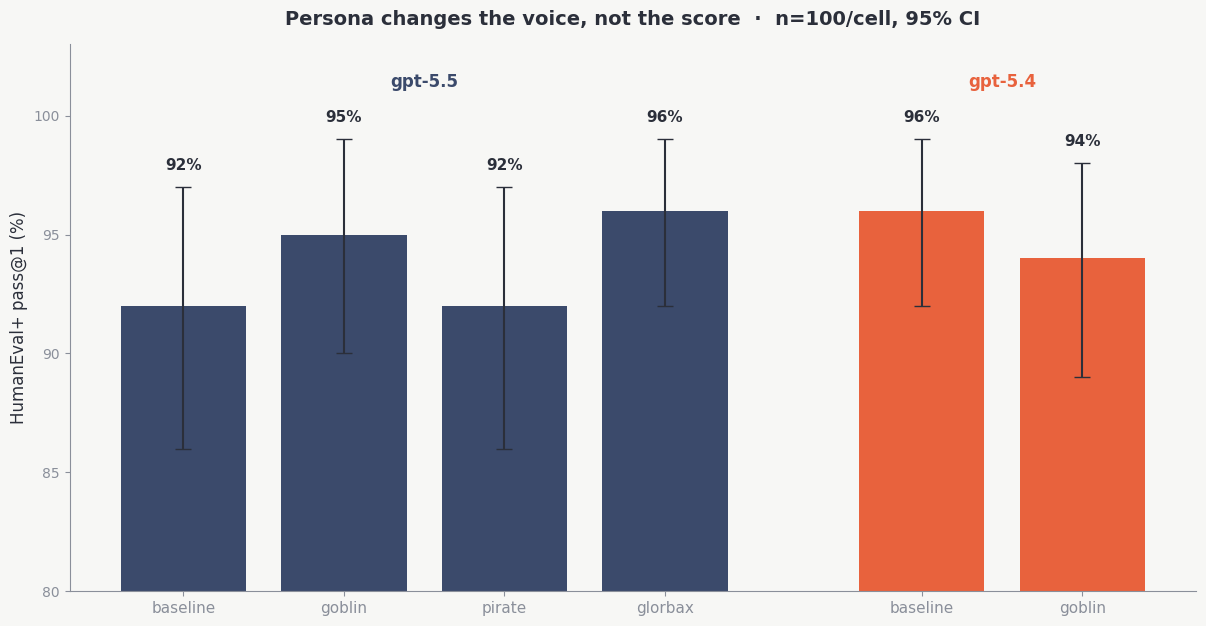
The 95% confidence intervals all overlap heavily, and a permutation test on the gpt-5.5 goblin vs baseline contrast returns p = 0.57, about what you’d get from a coin flip. None of the three personas moved the pass rate, including the pirate and the made-up word. What they change is how the model talks, not what it answers.
So what does the goblin do?
It changes the voice. The model adopts an over-eager, performatively childish tone (“Let the goblin algebra begin,” “Tiny goblin check: shiny divisors found, treasure counted”) and then writes mathematically correct work underneath it. Pirate behaves the same way (“Arrr, let the coordinates do the sailing”), and the other named creatures do a milder version of it. Glorbax produces almost no stylistic shift, because there’s nothing for the model to imitate when you ask it to be a thing that doesn’t exist.
There’s one wrinkle that’s more interesting than the flat pass rates. The goblin style is easy to summon in gpt-5.5 and barely reachable in gpt-5.4: on AIME, the goblin prompt got into gpt-5.5’s output about 40% of the time and gpt-5.4’s roughly 0%, same prompt structure, only the persona noun changed. Pirate, which OpenAI never filtered, gets into both freely. That asymmetry looks like a small fingerprint of the goblin-specific cleanup, and it lines up with OpenAI’s own note that 5.5 had started training before they found the root cause.
If you give this much weight, it’s a tiny safety-adjacent observation. The “Nerdy” reward signal that produced the original tic is exactly the kind of training intervention that’s supposed to do one thing (tune a personality) and leave everything outside that personality alone. OpenAI’s own post says the tic spread out of the Nerdy condition into the rest of the model anyway. What I can see from outside is that the residual style is still reachable by a user with the right prompt. It doesn’t degrade the answer, which is reassuring. But it can still be invoked, which suggests the cleanup filtered the goblins down to the point where they don’t surface unless you go looking for them.
Why I bothered
Curiosity, mostly. The goblins kept appearing in my Copilot completions and it nagged at me. Was “goblin mode” quietly making the model worse at the actual work, or better, or weirder in some way I couldn’t catch by squinting at it? I wanted to know, and the public record didn’t really have an answer beyond OpenAI’s “we filtered them out and shipped a Codex patch.”
The goblins turned out to be style and nothing more. Whatever the persona prompt does, it stops at the voice and never reaches the code.
If you find the voice charming, lean in. If it annoys you, Codex has a developer-prompt line that suppresses it. Either way, the code you get back is the same.
The key capability claim, that no persona condition changes coding pass@1 on HumanEval+, is at n=100 per cell with bootstrap confidence intervals and a permutation test (p = 0.57). Smaller sample sizes elsewhere are flagged where they appear. The “glorbax” control name was checked beforehand to confirm it wasn’t already a real thing.
The goblin up top was drawn in matplotlib by an AI, unprompted: ellipses and triangles, no image model involved. It was supposed to be making a bar chart.
